
Shhh
What could be the modern visual interpretation of the ancient transcendental meditative state? A project that begins with researching the significant visual connotations of meditation in the past and ends in an attempted creation of a new one. A 3000-year-long visual journey from a sacred tradition to a mainstream health exercise.
Probably the very first visual clue of meditation was found on a carved seal - on it, a yogi sitting in meditation pose - dating back to the Bronze Age (c. 2600 BCE). (s) Around 800-500 BCE, the Upanishads were eventually written down, popularising meditative practices across India. (s) The teachings began to spread along the Silk Road around the 5th century BCE. Across Asia, early Buddhism, among others such as Taoism, Hinduism, and Jainism, developed its own form of meditation and iconised the meditating Buddha figure, which spread across the continent.
It reached the West by the 3rd century BCE through Greek philosophers who developed practices such as naval gazing and omphaloskepsis. (s) After the 4th century AD, when Christianity began to dominate, contemplative traditions were suppressed in Europe for many centuries. However, contemplative prayers and other forms of Christian meditation did appear, such as the Jesus Prayer and Lectio Divina (divine reading). (s)
Shiva Pashupati, Indus Valley civilisation, c. 2600 BCE


Buddha in Meditation, late 6th -mid 7th century

Omphaloskepsis, 2nd century

Triptych with the Annunciation, known as the Merode Altarpiece, Robert Campin, 1428

The Virgin Mary Praying, unknown, 19th century

Te Monk, Henri Matisse, 1903
The Mocking of Christ, Fra Angelico, 1439-43 (section)

During the 17th century, the most important texts of Eastern philosophy were translated into European languages, and throughout the 19th century, the transcendentalist/romantic movement became widely popular throughout the West. (s)
By the 20th century, the intensified attention was followed by the migration of several Indian spiritual yogis - starting with Swami Vivekananda in 1893, followed by many such as Yogananda, Osho and Swami Rama - to the USA. (s) A new era began when scientific researchers pursued yogic practices, sparking interest over the next decades as they continually probed the effects of meditation on the body. In the 21st century, it became a mainstream secular practice, with several health benefits documented. As a result, meditation is no longer considered just a religious practice. (s)

Psychedelic meditation, unknown
%20studied%20by%20Prof_%20Richard%20J_%20Davidson%2C%202016.jpeg)
Yongey Mingyur Rinpoche (Tibetian Buddhist) studied by Prof. Richard J. Davidson, 2016

Maharishi Mahesh Yogi, Life Magazine, 1968
Using modern 3D scanning technology, I created a mask from a scanned face to symbolise the viewer. The pointing finger is held to the lip, asking the viewer to be silent. The closed eyes, as in Buddhist sculptures, represent internal gazing. The mask itself, reminiscent of Greek sculptures, in a pompous pink, is positioned farther away in a dark void, visualising the body fading away with the outer world as the meditation deepens.
Thus, a new visual composition aims to redress old religious imagery, seeking to reach a new generation with the same 3,000-year-old information.

Osho with Rajneeshes, Rajneeshpuram
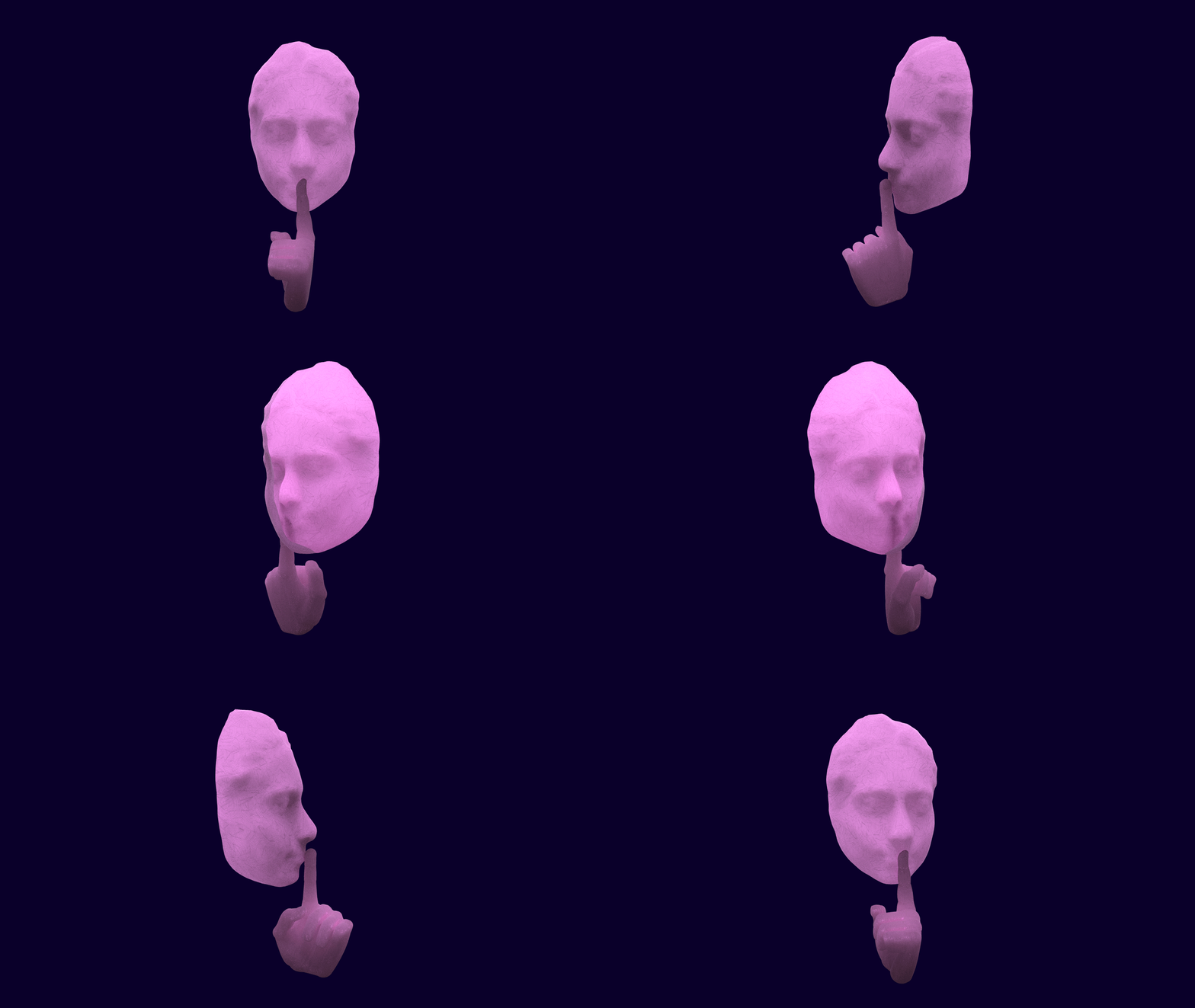

Shhh poster, original artwork, 2018